| Keyword | Search Volume |
|
Fpc pcb design |
50 |
|
flex circuit cost |
20 |
Features
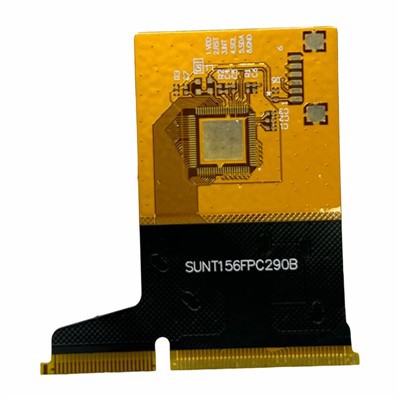
Optical module FPCs have particular characteristics to satisfy mechanical, thermal, and electrical needs of high-speed environments such as optical transceivers and active optical cables (AOCs).
|
Thickness |
0.08mm to 0.2mm Minimum two mil (50 µm) line width/spacing |
|
Copper Type |
RA, rolled-annealed |
|
Surface Finish |
Immersion Tin, ENig, OSP Minimum 0.5mm bending radius |
|
operating temperature |
-40°C to +125°C |
Essential for multi-gigabit data rates-e.g., 10G, 25G, 100G, 400G-accurate impedance control guarantees signals travel free from reflection or distortion. This is accomplished with deliberate control of dielectric constants, layer stack-ups, trace widths, and spacing.
FPCs shine in small designs, fitting for constrained areas and allowing dense component placement in form factors including SFP, SFP+, QSFP, SFP28, and OSFP.
Adjustability: Made from flexible substrates like polyimide (PI), FPCs can bend, twist, or fold to match complex module housings. They might be built for single-bend installations or dynamic flexing-that is, in AOCs.
To control heat from high-speed ICs, FPCs-despite their thinness-can include thermal vias, heavier copper weights, or heat-dissipating materials, so guaranteeing dependable operation across temperature ranges.
Properties of Materials: For high-speed, high-temperature environments, high-performance dielectric materials including polyimide provide outstanding thermal stability, chemical resistance, and electrical characteristics. High-frequency uses find low-loss dielectrics.
For component attachment (e.g., BGA pads), FPCs support fine trace widths, spacing, and fine-pitch features, so enabling high connection density in constrained areas. For connectors, also.
Direct connections to components and host boards allow FPCs to often replace large connectors or wires, so improving dependability and lowering signal path length. High-frequency signals are handled by surface finishes including Electroless Nickel Immersion Gold (ENIG).
Benefits in Optical Module FPC
Optical Module FPC improves performance, dependability, and manufacturing efficiency by means of several advantages.
- Excellent signal integrity and low electromagnetic interference (EMI) produced by precise impedance matching and reduced signal path lengths help to support low bit error rates at high data rates.
- Weight savings and space: For high-density networking equipment where physical restrictions are major, FPCs' thinness and flexibility help to reduce space and weight.
- FPCs can simplify assembly by including integrated connectors or termination pads, so lowering possible manual handling and possible mistakes. Fewer connections improve general dependability.
- Especially in uses like AOCs involving repeated movement, FPCs resist mechanical stress and vibration better than rigid boards or soldered wires.
- FPCs allow optimization for particular optical module requirements by means of highly customizable form, size, layer count, and electrical properties, so minimizing footprint.
- By streamlining assembly processes and simplifying the bill of materials-fewer connectors, less wiring-with lower flex circuit cost in mass production.
Fast-paced FPC Design and Performance Standards
FPC PCB Design for optical modules calls for great adherence to standards guaranteeing consistent high-speed data transfer.
High-speed signals need constant impedance-usually 50 Ohm for single-ended signals, 100 Ohm for differential couples-to stop reflections. This comprises exact control of trace widths, spacing, dielectric properties, and distances to reference planes.
Minimizing signal loss, crosstalk, and jitter is vital even beyond impedance. This is achieved in part by low-loss dielectric materials, short trace lengths, smooth routing, and strategic ground plane placement.
As modules shrink and heat generation rises, FPCs must control heat through higher copper weights, thermally conductive adhesives, or thermal vias. The best substrate is polyimide since of its great thermal stability.
FPCs have to resist bending without delamination or cracking. Particularly for dynamic flexing uses, design factors include minimum bend radius, flexible copper foils, and adhesives fit for the needed flexion.
Optical module designers and FPC manufacturers must work closely; often using simulation tools to forecast signal integrity and thermal performance before production.
Quality Control
Yixin Technology guarantees the dependability of FPCs for optical modules by means of a thorough quality control system.
Arriving materials-flexible laminates, copper foil, coverlay, stiffeners-are tested to meet performance criteria including dielectric constant and flexibility.
Continuous inspections in imaging, etching, laminating, drilling, and plating use automated optical inspection (AOI) and electrical testing to find flaws including circuit opens or shorts.
Precise measurements guarantee drilled holes, rout profiles, and trace widths satisfy tight tolerances for compact optical modules.
Based on customer needs, finished FPCs go through TDR impedance analysis, mechanical testing-such as flex endurance-and environmental testing-such as thermal cycling.
Complete visual and electrical inspection guarantees surface finish quality, solder mask alignment, and 100% netlist connectivity.
Robust systems guarantee traceability of materials and procedures for every batch, so facilitating thorough investigation if necessary.


About Yixin Technologies
Based in China, Yixin Technology is an OEM/ODM producer of flexible printed circuit boards ranging in single-sided, double-sided, multi-layer, flex-rigid, High-Density Interconnect (HDI) FPCs. Deep knowledge of flexible and flex-rigid PCBs helps us to provide customized solutions for demanding uses.
Our deep knowledge in FPC technologies and advanced manufacturing capacity enable us to provide tailored solutions guaranteeing signal integrity, thermal management, and flawless integration inside the small form factors of optical transceivers and corresponding components.
From design review to production, we offer end-to-end assistance to guarantee manufacture and quality for unique projects.
Meeting the strict criteria of international electronics companies, we export to markets including North America, Europe and Australia.
FAQ
Q: How can impedance be controlled?
A: Using exact design and manufacturing processes including consistent dielectric thickness, tight trace tolerances, and simulation tools to validate designs, Yixin Technology For every batch, time domain reflectometry (TDR) testing guarantees impedance accuracy.
Q: Are customizing FPCs possible?
A: Indeed, from concept to manufacturing, Yixin Technology, an OEM/ODM manufacturer, closely interacts with customers to create custom FPCs matched to their optical module designs.
Q: Normally, what are lead times?
A: Design complexity, materials, layer count, order volume all affect lead times. Usually with specific timelines decided upon following design review, prototypes have shorter lead times than mass production.
Q: What quality criteria are followed?
A: With strict quality control all through the manufacturing process to guarantee consistency and traceability, Yixin Technology follows IPC standards (e.g., IPC-6013 for flexible boards) and ISO certifications.
Hot Tags: optical module fpc, China optical module fpc manufacturers, suppliers, factory, Side Button FPC, Automotive Lighting FPC, Screen Transfer FPC, Hair Growth Cap FPC, Headset FPC, quick turn flex pcb